About InnovATEBIO

Overview
InnovATEBIO is a National Center for Biotechnology Education located at Austin Community College, in Austin, Texas. Center leaders are located at Forsyth Technical Community College, North Carolina; Finger Lakes Community College, New York; Digital World Biology, Washington; DNA Learning Center, New York; and MiraCosta College and BABEC in California.
Funding
InnovATEBIO is supported by DUE 2349809, a five-year ATE (below) national center grant from the National Science Foundation. Previously, the center was funded by NSF DUE 1901984.
Mission
InnovATEBIO works to advance the education of highly skilled technicians for the nation's biotechnology workforce. Toward this goal, InnovATEBIO provides leadership in biotechnology technician education, including support for development and sharing of best practices and emerging technologies in biotechnology workforce development.
Goals
-
Sustain, grow, and empower the community of biotechnology educators
- Maintaining and expanding the website, program database and services that support biotechnology educators,
- Developing a hub governance model for scaling and sustaining community support, and
- Preparing and disseminating outreach communication to broaden public awareness about careers in biotechnology to increase interest in technician education programs.
-
Support community and technical college faculty in educating the skilled biotechnology workforce
- Gathering industry’s workforce needs,
- Developing a faculty professional development model that includes hubs, industry partners, ATE projects and center leadership,
- Expanding opportunities for faculty to implement industry-relevant undergraduate research and work-based learning in emerging technologies, and
- Providing mentoring and outreach for ATE biotech projects and programs.
-
Enable community and technical colleges and state partnerships to shape the future of biotechnology workforce education
- Delineating biotechnology career pathways that integrate career, and technical education (CTE), non-CTE, and credentials that articulate between high school, and 2- and 4-year institutions of higher education with a focus on workforce education and policy,
- Fostering community college leadership in providing biotechnology workforce education,
- Assisting state teams in developing biotechnology workforce ecosystems, and
- Broaden participation in the biotechnology talent pipeline.
Ecosystem
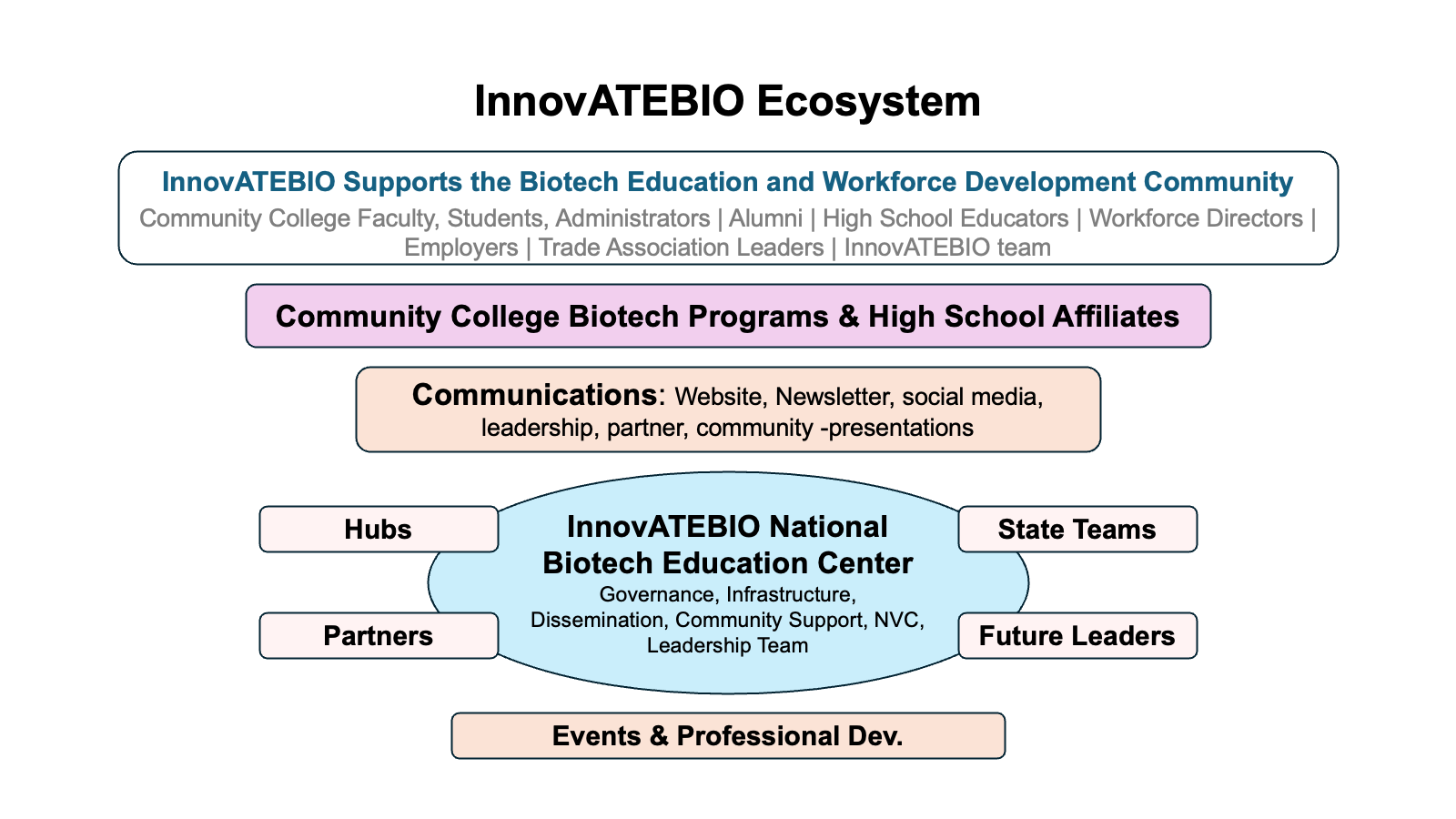
The InnovATEBIO Ecosystem illustrates how InnovATEBIO supports and connects the national biotechnology education and workforce development community.
At the top level, InnovATEBIO serves a broad and diverse audience, including community college faculty, students, administrators, alumni, high school educators, workforce directors, employers, trade association leaders, and the InnovATEBIO team itself. This community represents the full pipeline from education to employment.
Community college biotechnology programs and affiliated high schools form the primary educational foundation of the ecosystem. These institutions are supported and connected through coordinated communications, including the InnovATEBIO website, newsletters, social media, leadership outreach, partner engagement, and community presentations.
At the core of the ecosystem is the InnovATEBIO National Biotech Education Center, which provides governance, infrastructure, dissemination of resources, community support, national visiting committees (NVC), and overall leadership. This central hub enables coordination, consistency, and national impact.
Surrounding the national center are key engagement structures: hubs, state teams, partners, and future leaders. Together, these groups extend InnovATEBIO’s reach, ensure technical relevance, foster collaboration, and support leadership development across the country.
Finally, events and professional development activities anchor the ecosystem by providing opportunities for learning, networking, and continuous improvement, strengthening both educators and the biotechnology workforce nationwide.
Impact
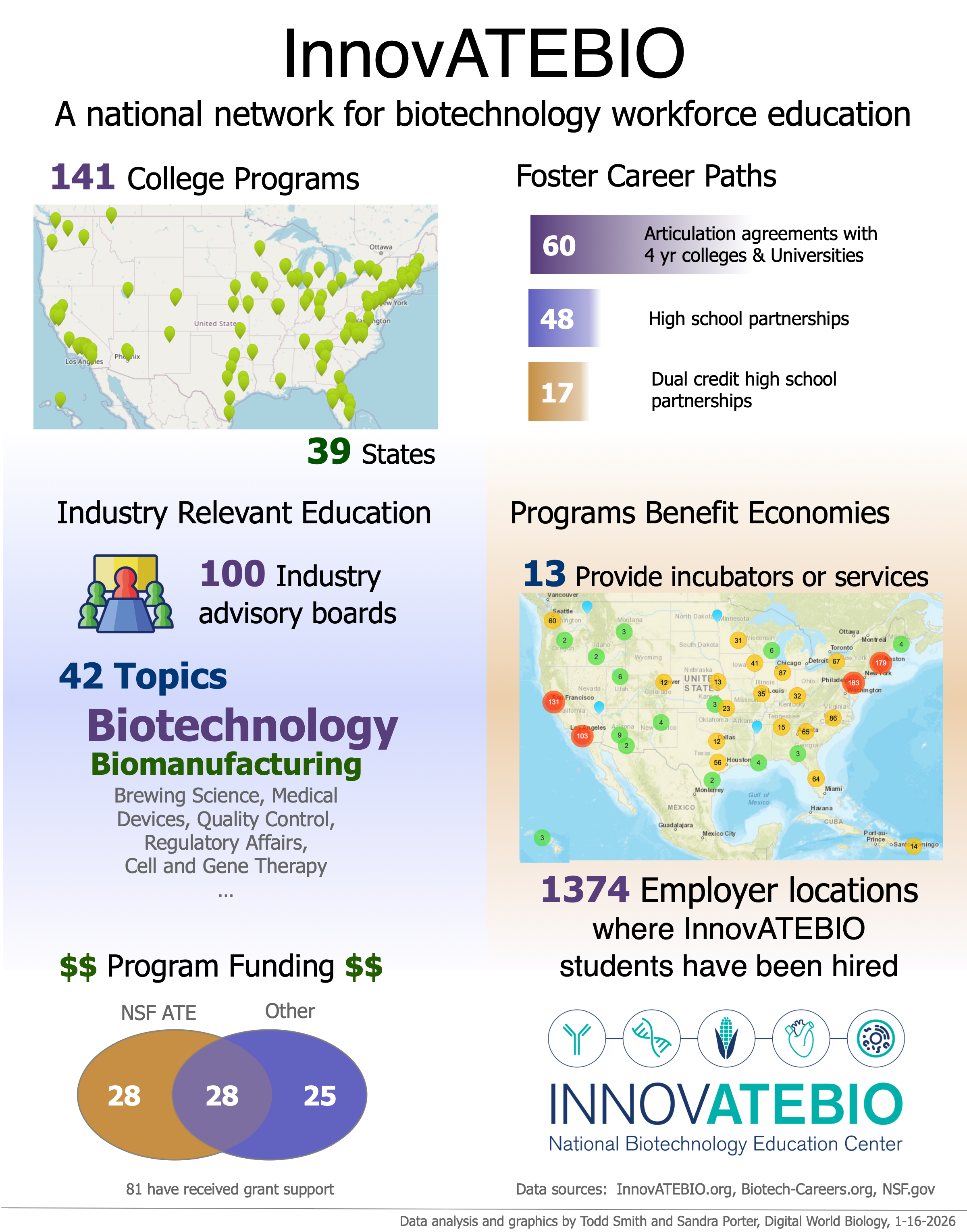
InnovATEBIO connects 141 community college biotechnology programs across 39 states, creating a broad, geographically diverse educational footprint.
The network supports clear career pathways through 60 articulation agreements with four-year colleges and universities, 48 high school partnerships, and 17 dual-credit high school programs, helping students move efficiently from secondary education into college and careers.
Industry relevance is maintained through 100 industry advisory boards and curriculum spanning 42 biotechnology and biomanufacturing topic areas, including brewing science, medical devices, quality control, regulatory affairs, and cell and gene therapy.
InnovATEBIO programs also contribute directly to regional economies. Thirteen programs provide incubators or business services, and InnovATEBIO students have been hired at 1,374 employer locations nationwide, demonstrating strong alignment with workforce needs.
Program sustainability is supported through multiple funding sources, including NSF Advanced Technological Education (ATE) grants and other funding, with 81 programs receiving grant support. Data are drawn from InnovATEBIO.org, Biotech-Careers.org, and NSF.gov.